
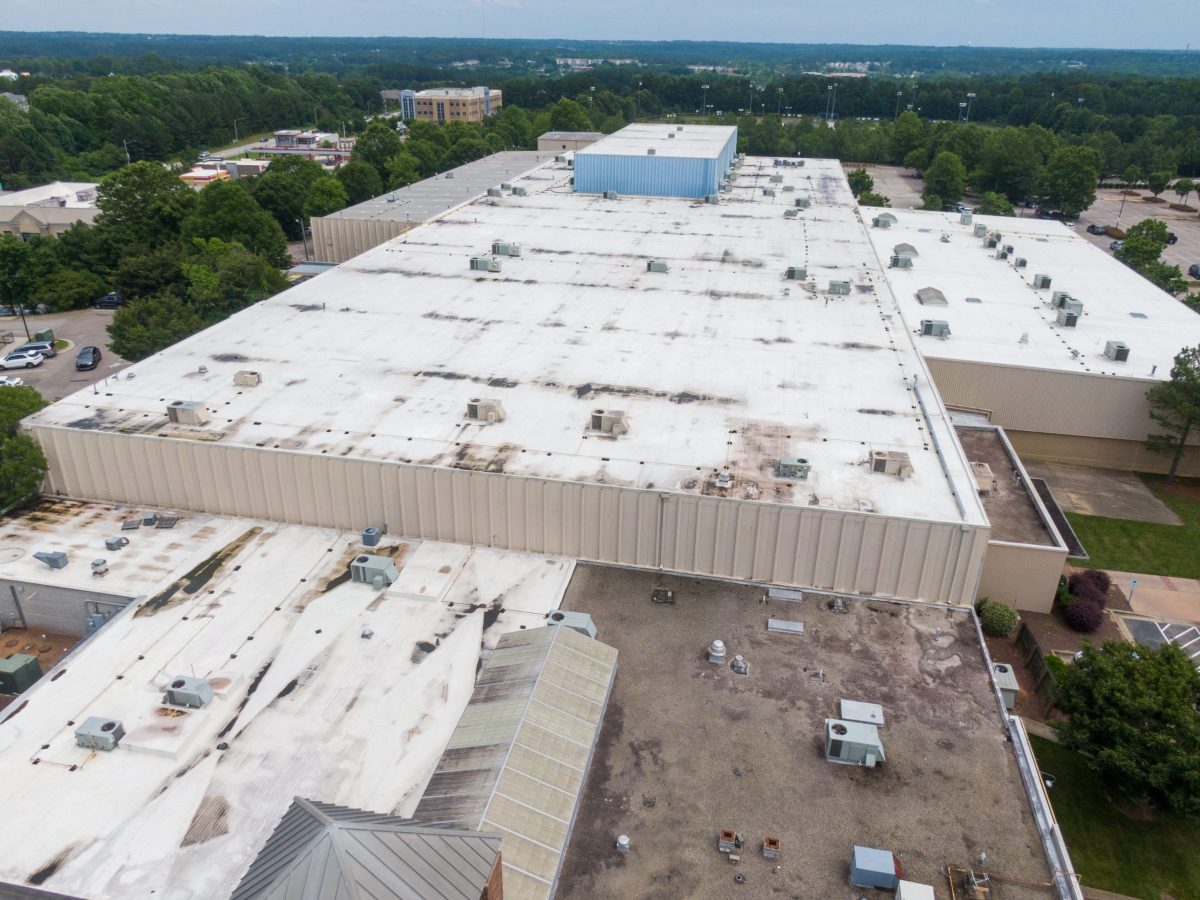
6 Signs of Hail Damage on a TPO Roof and Why You Should Act Fast
Hail damage on a TPO roof is one of the most underestimated risks in commercial property management, and the reason is simple: TPO membranes often look fine from the ground even when the roof system underneath has taken a serious hit. TPO (thermoplastic polyolefin) is one of the most popular single-ply roofing membranes on commercial buildings today because it is durable, energy-efficient, and cost-effective. But that same tough surface can hide impact damage for months, and by the time the leaks show up, the warranty deadline and the insurance filing window may already be gone.
Here is what you will learn in this guide:
- The 6 signs of hail damage on TPO: What to look for on the membrane, seams, flashings, and substrate.
- Why the damage matters more than it looks: How hail affects the layers underneath the membrane.
- What to do right away: How to protect your warranty, insurance claim, and building.
Why Hail Damage on Commercial TPO Roofs Is Different

TPO roofs handle hail differently than asphalt shingles or metal, and the damage patterns are unique. Understanding those patterns is what separates a proactive inspection from a reactive leak call six months later.
How Hail Actually Affects a TPO Membrane
When a hailstone strikes a TPO roof, the damage happens in three layers: the membrane itself, the cover board and insulation below it, and the seams that hold the whole system together. A hailstone as small as 1.5 inches can crack a 45-mil membrane, especially if the impact lands directly over a fastener plate or seam. Larger hail can compress the membrane into the cover board underneath, causing hidden fractures that only reveal themselves as slow leaks in the months that follow. Property managers in Center and surrounding areas frequently discover TPO hail damage weeks or months after the storm passes, once ceiling stains or moisture readings finally appear.
- Membrane damage: Cracks, punctures, tears, or fractures directly under the impact point.
- Substrate damage: Compression fractures in the cover board or insulation below.
- Seam compromise: Heat-welded seams weakened by nearby impacts.
- Delayed symptoms: Leaks often appear weeks or months after the initial hit.
Why Acting Fast Matters More on Commercial TPO Roofs
Commercial hail damage claims run on shorter timelines than most building owners realize, and the physical damage worsens with every freeze-thaw cycle and heavy rainstorm. According to IIBEC (International Institute of Building Enclosure Consultants), a 2023 inspection of 38 buildings in Austin, Texas hit by 1.75 to 3-plus inch hail found that every roof installed over a soft substrate suffered damage, while roofs installed over dense cover boards showed no functional damage from the same event. That variability is why an expert inspection matters so much: the exact same storm can leave one building’s TPO fully intact and another’s structurally compromised. Waiting to inspect can cost you the ability to prove which storm caused which damage.
- Insurance windows: Many commercial policies require notice within 30 to 60 days of the event.
- Warranty conditions: Some TPO manufacturer warranties void if hail damage is not documented promptly.
- Damage progression: Freeze-thaw cycles and UV exposure widen existing cracks over time.
- Business impact: A leak inside your building can force closures, damage inventory, and disrupt tenants.
6 Signs of Hail Damage on Your TPO Roof
A trained inspector looks for six specific damage patterns after any hail event. Recognizing these signs is what turns a “looks fine” survey into a documented case for repair or replacement.
1. Impact Marks and Spatter on the Membrane
Hail impact marks on TPO typically appear as circular indentations or “spatter marks” where the hailstone struck the membrane surface. On a light-colored TPO membrane, these often show up as darker circles or scuffed rings 1 to 3 inches in diameter, sometimes with a slight depression at the center. On dirty or aged membranes, spatter marks appear as unusually clean spots where the dirt was blasted away by the impact. These marks are important because they give inspectors an accurate record of the hail size and impact frequency, even if the membrane itself is not yet punctured.
- Circular spatter: Round dark or clean spots on the membrane surface.
- Slight indentation: A visible depression at the impact point.
- Clean spots on aged TPO: Where hail blasted away accumulated dirt.
- Pattern matters: Random distribution across the roof, not linear or clustered.
2. Punctures and Tears in the TPO Membrane
Punctures or tears in the TPO membrane are the most serious form of hail damage because they represent a direct path for water to reach the insulation and structure below. Punctures often appear as small holes or slits, sometimes hidden inside a spatter mark and easy to miss without close inspection. On thinner membranes (45-mil), even 1.5-inch hail can create punctures, especially over fastener plates where the membrane compresses against a sharp edge. Any puncture, no matter how small, needs immediate attention because water infiltration can saturate the cover board and insulation within days.
- Small punctures: Pinholes or slits hidden inside impact marks.
- Fastener-plate splits: Cracks that form where hail hits directly over a fastener.
- Membrane thickness matters: 45-mil is more vulnerable than 60-mil or 80-mil.
- Immediate risk: Water infiltration begins with the next rainfall.
3. Fractures and Starburst Cracks Near Impact Points
Fractures on TPO membranes often appear as small linear cracks or “starburst” patterns radiating out from an impact point, especially over stress-concentrated areas like insulation joints or fastener plates. These fractures can be difficult to see at first because they may not extend fully through the membrane. Over time, temperature swings and normal building movement widen these cracks until they become active leak points. A close inspection with the right lighting and moisture-scanning equipment usually reveals fractures that are invisible to the naked eye from more than a few feet away.
- Starburst pattern: Small linear cracks radiating from an impact center.
- Stress-point cracks: Fractures above insulation joints or fastener locations.
- Progression: Hairline today, active leak in 60 days.
- Detection tools: Moisture meters and infrared scans reveal hidden fractures.
4. Damaged Seams and Membrane Edges

Seams are the weakest points on any TPO roof system, and hail impacts near a seam can weaken the heat-weld bond even when the membrane surface looks fine. Damaged seams often appear as slight lifting, discoloration, or a wrinkled appearance along the weld line. Edge terminations, drip edges, and corner details take extra abuse during a hailstorm because they are already under stress from thermal cycling. Any damage in these areas needs prompt professional review because seam failures are one of the most common causes of TPO roof leaks after a hail event.
- Lifted seams: Visible separation or wrinkling along a heat-weld line.
- Discolored welds: Off-color patches suggesting bond weakness.
- Edge damage: Compromised terminations at parapets and drip edges.
- Common failure point: Seams account for a large share of post-hail leaks.
5. Damage to Flashings, Curbs, and Rooftop Equipment
Rooftop equipment and any raised feature on your commercial roof are prime targets during a hail event, and damage to these components often shows up more clearly than damage to the flat membrane. HVAC unit fins get bent or crushed, condenser cabinets show dents, vent stacks may split or crack, and skylight domes can crack or shatter entirely. The membrane flashings that wrap around these features are especially vulnerable because they combine sharp edges, thermal stress, and complex geometry. Damaged flashings are a leading cause of leaks near rooftop equipment after any severe storm.
- HVAC damage: Bent fins on condenser units and dented cabinets.
- Skylight and vent damage: Cracked domes, split vent stacks, and broken caps.
- Flashing failures: Torn or lifted membrane wrapping around curbs and penetrations.
- Collateral evidence: Bent metal on rooftop equipment confirms storm severity.
6. New Ponding Water and Low Spots
New ponding water on a TPO roof after a hail event is a strong sign that the insulation or cover board below the membrane has been compressed by impact. Large hail can crush polyisocyanurate or fiberboard insulation without damaging the membrane visibly, creating a shallow depression where water now collects. These low spots accelerate membrane aging, add unexpected weight to the roof deck, and often mask hidden leaks from earlier damage. Any ponding water that was not there before the storm should be documented and investigated during a full roof inspection.
- New depressions: Low spots that hold water 48 hours after rain.
- Hidden cause: Crushed insulation or cover board below an intact membrane.
- Accelerated aging: Ponding water breaks down TPO faster than a properly drained roof.
- Load risk: Added weight from standing water stresses the roof deck.
What to Do If You Find Hail Damage on Your TPO Roof
Documenting hail damage on a commercial roof is only step one. The steps that follow determine whether your insurance claim succeeds, whether your warranty stays valid, and whether your building keeps performing.
When Should You File a Commercial Insurance Claim?
You should file a commercial insurance claim as soon as your independent roof evaluation confirms hail damage, typically within 30 to 60 days of the event. Waiting past that window can trigger late-notice denials, even when the damage is clearly storm-related. Before filing, get a thorough written evaluation from a licensed commercial roofing contractor with photos, moisture readings, and a scope of damage by area. That documentation gives your adjuster a clear baseline and prevents legitimate damage from being missed during their inspection.
- File promptly: Most policies require notice within 30 to 60 days.
- Get written documentation: Photos, moisture readings, and a damage scope report.
- Attend the adjuster’s inspection: Walk the roof with them and point out documented damage.
- Request the report in writing: Full inspection notes and itemized settlement estimate.
How Do You Choose the Right Commercial Roofing Contractor?
Choose a commercial roofing contractor who is licensed, insured, experienced with TPO systems, and able to provide references from similar commercial buildings in Center and surrounding areas. TPO installation and repair require specific training in heat welding, seam probing, and manufacturer-approved installation methods, and not every roofer has that experience. Ask about manufacturer certifications, warranty backing, and previous storm-response work. Be cautious of any contractor asking you to sign an assignment-of-benefits agreement before your insurance adjuster has evaluated the roof.
- Verify credentials: General liability insurance, workers compensation, and manufacturer certification.
- Check TPO experience: Ask specifically about TPO installations and hail repair history.
- Get written estimates: Itemized by scope, materials, and labor.
- Avoid pressure tactics: Reputable contractors give you time to evaluate the offer.
Frequently Asked Questions About Hail Damage on TPO Roofs

How much hail size does it take to damage a TPO roof?
Hail as small as 1 inch in diameter can leave impact marks on a TPO roof, and hail 1.5 inches or larger can puncture standard 45-mil membranes, especially over fastener plates. Thicker 60-mil or 80-mil TPO holds up better but is still vulnerable to hail 2 inches or larger. Any hail event with reported stones larger than 1 inch warrants a professional roof evaluation.
Can hail damage on a TPO roof be repaired?
Yes, isolated hail damage on a TPO roof can often be repaired by patching the affected areas with matching membrane and heat welding it in place. Widespread damage across multiple areas, or damage to the cover board and insulation below, usually calls for full replacement of the affected sections. A qualified commercial roofer will identify which approach fits your damage pattern.
Does insurance cover TPO hail damage?
Most commercial property insurance policies cover hail damage to TPO roofs when the damage is documented and reported within the policy’s notice window. Coverage varies by policy, and some carriers apply higher deductibles for wind and hail losses. Your documentation from a licensed commercial roofer strengthens the claim significantly.
How long do I have to file a hail damage claim?
Most commercial insurance policies require notice within 30 to 60 days of the storm, though some named-storm provisions are shorter. Check your declarations page for the exact window that applies to your building. When in doubt, file as soon as possible and supplement the claim with more documentation as your inspection continues.
Will hail damage void my TPO warranty?
Unaddressed hail damage can void the manufacturer’s warranty on your TPO membrane, especially if the damage is discovered later and not repaired promptly. Most warranties require the building owner to report and address any damage as soon as it is identified. Prompt inspection and repair after a storm protects both your warranty and your insurance position.
How often should a commercial TPO roof be inspected?
A commercial TPO roof should be professionally inspected at least twice a year, plus after any major hail, wind, or storm event. Regular inspections catch small issues before they become large ones and provide the documentation trail insurers and manufacturers require to honor claims and warranties.
Why M&M Roofing Is Your Trusted Partner for TPO Hail Damage
Every day that passes after a hail event on your TPO roof is a day the damage progresses and your window for warranty and insurance protection shrinks. M&M Roofing serves commercial property owners in Center and surrounding areas with thorough TPO roof evaluations, documented reports for insurance claims, and repairs backed by available warranties, financing options, and our commitment to building the strongest shell for your property from the deck to the drip edge.
If a storm just passed through and you own or manage a commercial building with a TPO roof, contact M&M Roofing today for a free, no-obligation evaluation. A prompt look now protects your warranty, your insurance claim, and the operations happening inside your building.
